
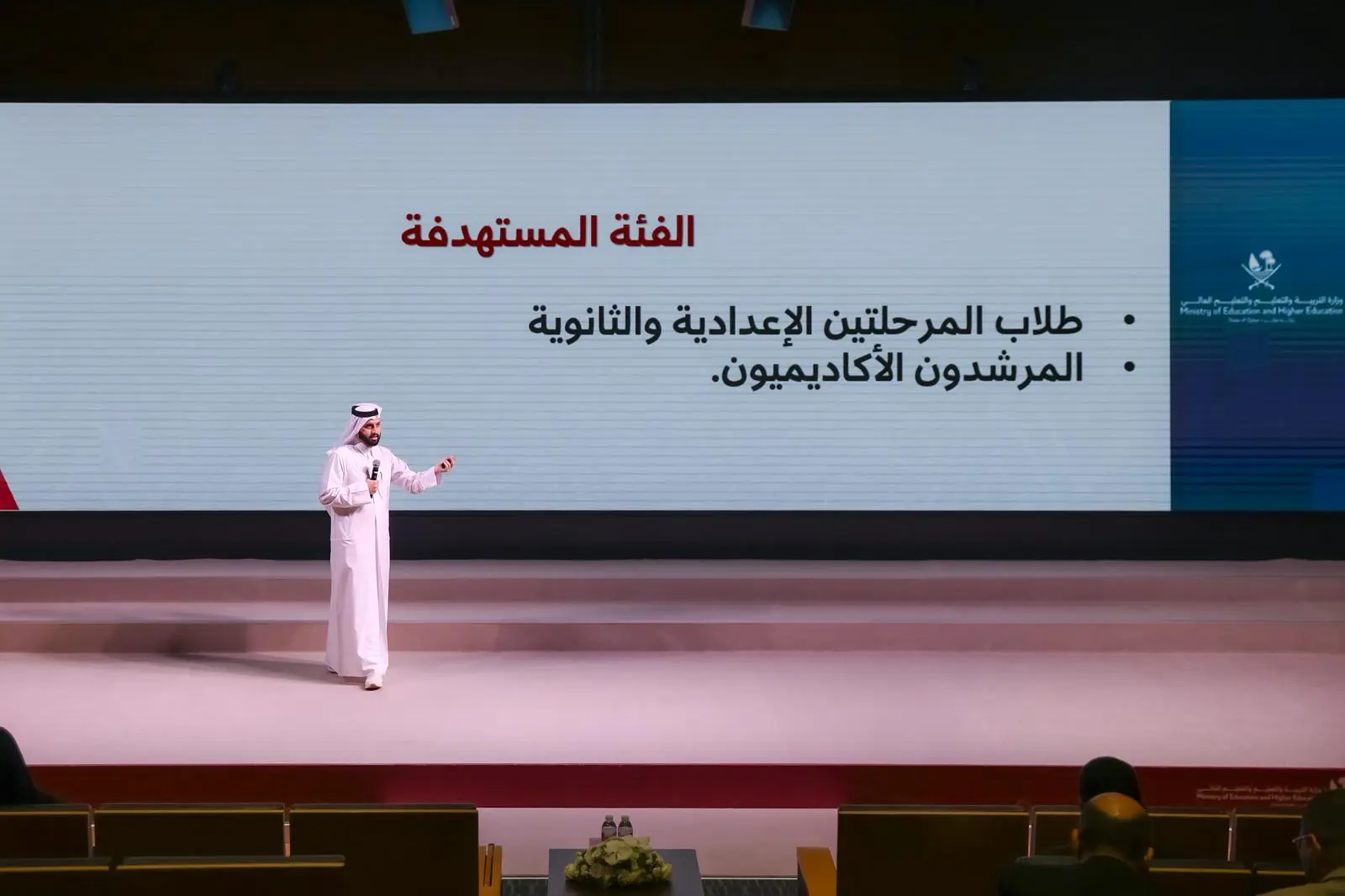
The Ministry of Education and Higher Education, represented by the Department of Schools and Students Affairs – Academic and Career Guidance Section – organised the Forum on Outstanding Practices in Academic Guidance for the 2025–2026 academic year at the ministry’s permanent headquarters theatre hall. The event was held as part of the ministry’s ongoing efforts to develop the academic and career guidance system, enhance the quality of educational outcomes, and empower students to make informed educational and career decisions based on their interests and academic abilities.
The event was attended by Ms Warda Mohammed Aqeel, Assistant Director of the Department of Schools and Students Affairs at the ministry, senior officials, academic counsellors from government schools, Ms Al Anoud Al Nuaimi, Director of Workforce Planning at the Government Sector, and Ms Bana Al Subaie, Assistant Director of Workforce Planning at the Civil Service Bureau.
In her opening speech, Ms Warda Mohammed Aqeel stressed the importance of academic guidance in directing students and enabling them to make educational decisions based on a deep understanding of their abilities, interests, and labour market needs. She noted that the distinguished practices witnessed in the educational field reflect the efforts of academic counsellors within the education sector.
She explained that the ministry has developed the academic and career guidance system to guide students toward scientific and technological pathways in line with the country’s directions, emphasising that the tangible results achieved in this field are the outcome of continuous cooperation between schools and educational staff.
For her part, Ms Ebtisam Mohammed Al Yafei, Head of the Academic and Career Guidance Section at the Department of Schools and Students Affairs, stated in her speech that academic and career guidance has become an integrated system that begins with identifying students’ interests and abilities, guiding them toward suitable educational pathways, and preparing them for university and the labour market.
She explained that the role of the academic counsellor is based on several key areas, including activating early guidance, analysing student data using scientific tools to measure interests and abilities, providing individual and group counselling, preparing students for standardised tests such as SAT, ACT, and IELTS, strengthening partnerships with parents, and aligning educational outcomes with labour market needs.
She also highlighted the importance of digital transformation in academic guidance through the use of platforms and data to provide more efficient guidance services, while stressing the importance of strengthening national partnerships with the Civil Service and Government Development Bureau, the Ministry of Labour, and both public and private sectors to connect educational outcomes with future job opportunities.
Ms Al Yafei also emphasised the importance of the academic counsellor’s role in early guidance toward educational pathways and scientific and technological specialisations that prepare students for in-demand careers in the labour market.
She reviewed the achievements of the Academic and Career Guidance Section during the 2025–2026 academic year, which added value to the percentage of students choosing scientific and technological tracks, increased the number of applicants for standardised tests, and boosted enrolment in government scholarship programmes, particularly the “Tomouh” programme and priority specialisations in medicine and engineering.
Ms Al Anoud Al Nuaimi, Director of Workforce Planning at the Civil Service and Government Development Bureau, also addressed the forum, emphasising the importance of the event as a bridge for advancing the academic guidance system and providing guidance based on a realistic understanding of national needs. She noted that successful workforce planning and addressing labour market gaps begin with unified efforts and effective communication with educational institutions.
She praised the role of academic counsellors, describing them as “the eyes through which students see their professional future and the hands that help them build the first steps toward national success.”
Ms Bana Salem Al Subaie, Assistant Director of Workforce Planning at the Civil Service Bureau, also spoke about the importance of academic guidance in identifying students’ interests and abilities and linking them to the labour market. She highlighted the role of guidance in reducing changes of majors, academic struggles, and university dropout rates, ensuring efficient investment in students’ time and state resources.
She stressed the importance of transforming guidance into a national strategy that serves labour market needs, unifies the vision between educational outcomes and labour market demands, strengthens investment in human capital, and provides students with a roadmap for shaping their future, while also achieving balance in student distribution across specialisations.
The forum included presentations of distinguished practices in academic and career guidance within schools, delivered by academic counsellors on preparing students to choose suitable specialisations and preparing them for the labour market. The presentations highlighted the role of academic guidance in supporting government scholarship programmes and its positive impact on directing students and enhancing informed educational and career decisions based on reliable information and students’ academic interests and abilities.
The event concluded with the recognition of schools that achieved added value in supporting academic and career guidance, particularly in attracting students to scientific and technological pathways. Outstanding academic counsellors, winners of the “Outstanding Counsellor” title for the 2025–2026 academic year, and focus group members were also honoured in appreciation of their efforts and contributions to developing the academic guidance system.
The forum also witnessed the Ministry of Education and Higher Education honouring the Civil Service and Government Development Bureau in recognition of its distinguished role and cooperation with the ministry. A commemorative shield was presented to Ms Al Anoud Al Nuaimi, Director of Workforce Planning.
It is worth noting that the forum represents an important platform for promoting a culture of distinguished academic guidance, exchanging expertise and best practices, encouraging innovation in guidance practices, and achieving integration between educational outcomes and labour market needs, contributing to preparing a generation capable of meeting future requirements and supporting national development.


