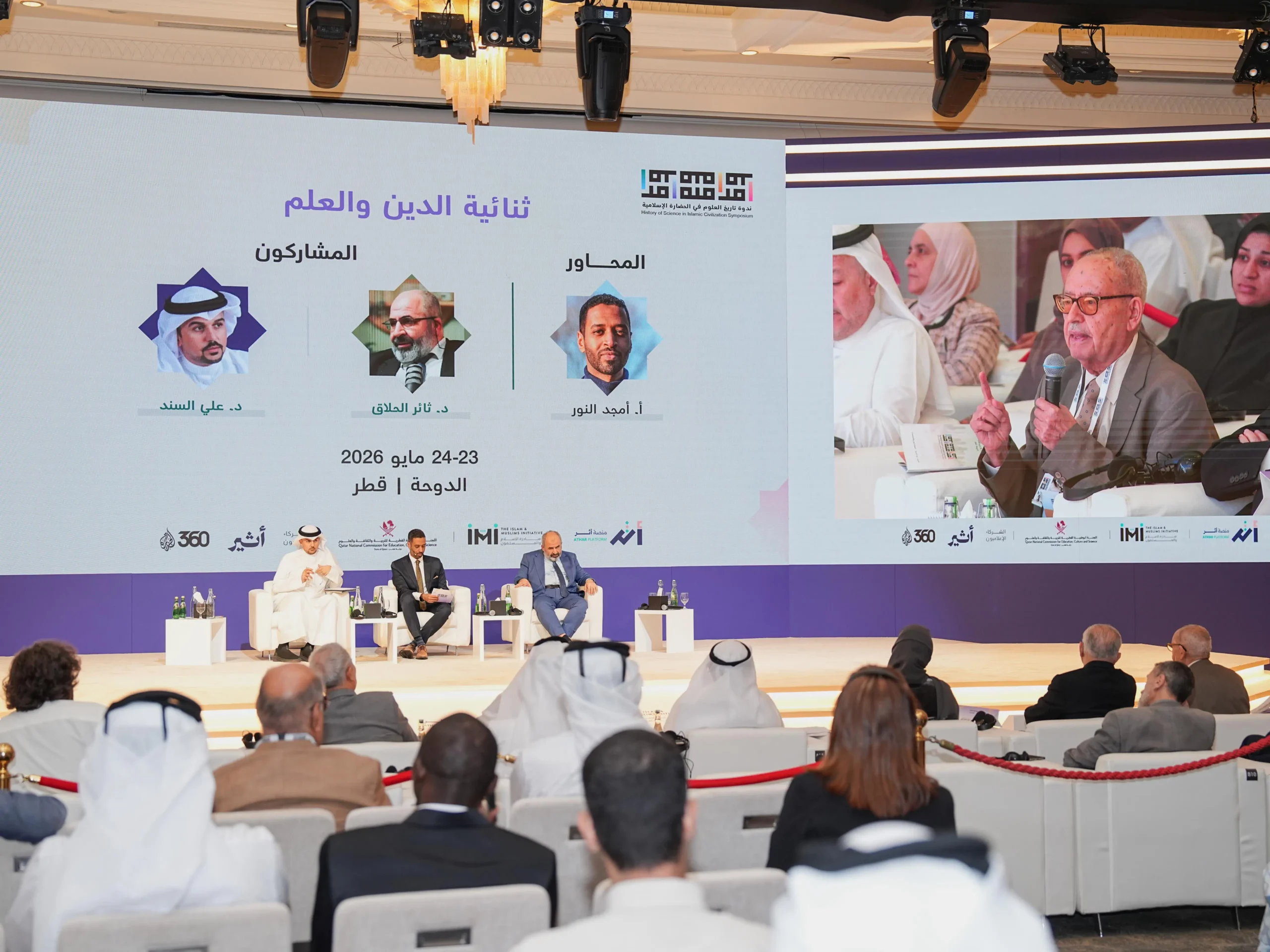
The activities of the “History of Science in Islamic Civilization” symposium, stemming from the International Conference on Orientalism, officially commenced today. The symposium is organised by the Ministry of Education and Higher Education and the Qatar National Commission for Education, Culture and Science, in cooperation with the “Islam and Muslims” initiative, at the Four Seasons Hotel in Doha, and will continue for two days.
The opening ceremony was attended by Her Excellency Lolwah bint Rashid Al Khater, Minister of Education and Higher Education, and His Excellency Dr Ibrahim bin Saleh Al Nuaimi, Undersecretary of the Ministry of Education and Higher Education, alongside senior ministry officials, distinguished scholars, researchers, academics, and interested participants from within Qatar and abroad, in addition to several ambassadors of Arab and Islamic countries accredited to the State of Qatar.
The symposium aims to reconsider the place of the history of Islamic science within the wider global history of science through a contemporary academic approach that moves beyond linear narratives and celebratory readings. It views this field as a rich source of knowledge for analysing the development of sciences, the transmission of knowledge, and the interaction between civilisations, contributing to a more balanced and deeper understanding of the history of human knowledge. The symposium also seeks to present simplified educational content to the public and transform scientific outcomes into broader community dialogue.
The symposium opened with a speech delivered by Professor Dr Mahmoud Al Hamza, Chairman of the Scientific Committee, who welcomed the attendees and expressed his gratitude to the researchers for their valuable participation, while also expressing his hopes that the symposium would achieve its intended goals. This was followed by the keynote lecture delivered by the prominent historian Professor Dr Ekmeleddin İhsanoğlu on the new trends in studying the history of Islamic science.
The symposium activities were divided into two academic tracks. The first was the specialised morning track, which included intensive academic sessions titled: “The History of Science and Islamic Scientific Thought”, “Networks of Knowledge and Science Transfer to and from the Islamic World”, concluding with a session on the history of medicine in Islamic civilisation.
The second track was the public evening track, dedicated to the wider audience with the aim of simplifying academic outcomes. It included a discussion session titled “The Duality of Religion and Science”, in addition to an open dialogue with Dr Ibrahim Al Khalifi under the title “Interdisciplinary Sciences: Questions of Meaning, Education, and Psychology”.
The first day concluded at the main theatre of the Doha International Book Fair with an open discussion moderated by Dr Fella Lahmar alongside Dr Shoaib Malik on his book “The Seven Traditions in the Relationship Between Islam and Science”, amid strong audience engagement and notable interaction from visitors and participants.
The symposium will resume tomorrow, Sunday, 24 May, covering additional themes including mathematics, astronomy, and the philosophy of science, amid growing academic and cultural interest in its anticipated outcomes.