
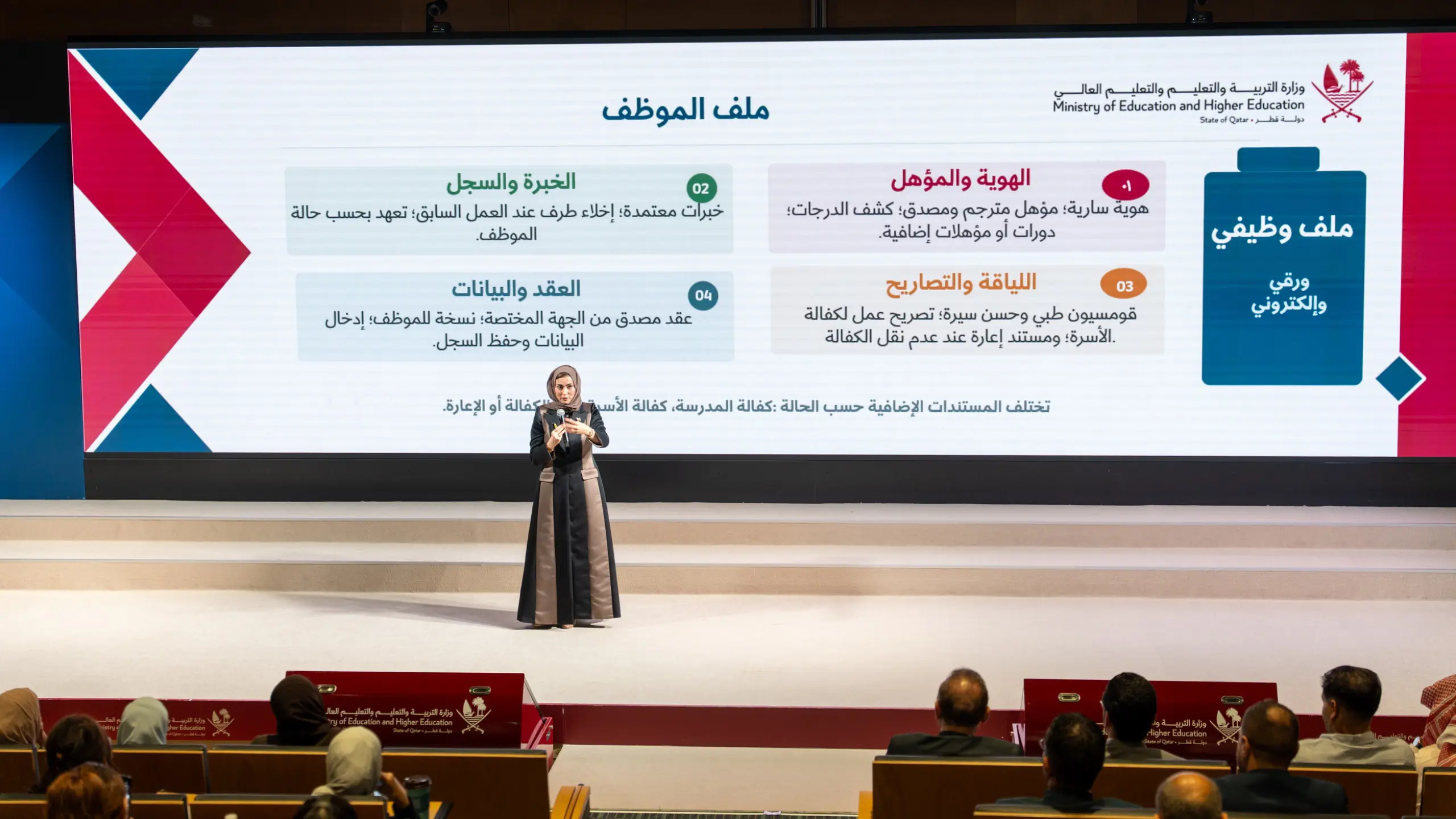
The Ministry of Education and Higher Education held the first forum for license holders of private schools and kindergartens under the theme “Towards a Flexible Investment Environment… and Sustainable Quality Education.” During the forum, the Ministry announced a comprehensive package of regulatory facilitations and incentive measures aimed at supporting and encouraging investment in the private education sector, streamlining procedures, and expanding educational opportunities available to families and learners across the country.
Dr. Rania Mohammed, Director of the Department of Private Schools and Kindergartens and Acting Director of the Department of Private School Licensing, highlighted during her keynote presentation that these measures are designed to simplify procedures and reduce administrative burdens on investors and educational institutions.
She explained that the Ministry has approved the standardization of the validity periods of all transactions and licenses issued by government entities, aligning them with the educational license period of three to five years. In addition, coordination with the Ministry of Interior has resulted in extending the validity of the traffic safety license to three consecutive years instead of requiring annual renewal.
The Ministry also updated tuition fee categories while increasing the number of available seats by 18% in medium-fee schools (Category 1), by reducing the required classroom space per student to 1.7 square meters. This adjustment is expected to create 6,883 new seats across 46 schools, including 688 free seats allocated to eligible students through corporate social responsibility programs.
Regarding the recruitment of teachers and staff, Dr. Rania Mohammed explained that the requirement to wait for the Ministry’s prior nomination approvals has been abolished. It has been replaced with a “declaration and undertaking” system, allowing schools greater flexibility to select and directly hire qualified candidates in accordance with approved requirements. The Ministry will continue to conduct field monitoring and verification to ensure that employees meet the required qualifications and adhere to national values and customs.
The Ministry also introduced a new category of “Distinguished Schools” for high-performing schools that provide advanced educational environments, utilize artificial intelligence technologies, and establish international partnerships. A framework has been developed linking tuition fees for these schools to their actual costs and additional services based on 20 clearly defined criteria, with the possibility of granting an incentive increase of up to 30% on basic tuition fees depending on the level of compliance with these criteria.
The presentation concluded by highlighting the expansion of the Educational Vouchers program for Qatari students. Under the new measures, newly established schools will be eligible to benefit from educational vouchers from the start of their operations, beginning in the 2027–2028 academic year, without having to wait for several years to obtain school accreditation. The initiative will also cover schools relocating to new buildings starting from the 2026–2027 academic year, as well as private kindergartens operating in separate buildings from the 2027–2028 academic year.


